
3.7 Stage 5 – End / Close out.
3.7.1 Union rapid information and data logging architecture (Safety Gate / ICSMS)
3.7.1.1 Article 34 of Regulation (EU) 2019/1020, in systematic coordination with Regulation (EU) 2023/988 (General Product Safety Regulation — GPSR, which definitively repealed Directive 2001/95/EC and succeeded the transitional guidelines of Commission Implementing Decision (EU) 2019/417), establishes the current integrated architecture for market surveillance reporting. For harmonised construction products, the primary statutory tool for risk logging and cross-border enforcement coordination is the Information and Communication System for Market Surveillance (ICSMS), which interfaces directly with the Union rapid alert system (Safety Gate) where products pose a serious risk to health, safety, structural integrity, or environmental protection objectives.
3.7.1.2 Member States are obliged to ensure that products which present a serious risk requiring rapid intervention, including a serious risk the effects of which are not immediate, are recalled, withdrawn, or that their being made available on the market is prohibited. In such circumstances, the Market Surveillance Authority, through the National Liaison Office, shall ensure that the European Commission and all other Member States are informed without delay via the ICSMS platform and, where applicable, the Safety Gate portal, in strict accordance with Articles 19, 20, and 34 of Regulation (EU) 2019/1020.
3.7.1.3 Notifications under Stage 5 relate to products for which a systematic risk evaluation has been identified whether through a complaint, laboratory failure, or the active enforcement actions of a market surveillance authority. In notifying the European Commission of any restrictive measures taken in connection with the recall, withdrawal, or prohibition of the marketing of products presenting a risk, Member States must provide comprehensive technical details of any measures recommended, imposed, or agreed with economic operators, as well as any voluntary actions taken by economic operators with respect to such products in order to trigger the formal Union Safeguard Procedure under Article 35 of Regulation (EU) 2019/1020.
3.7.1.4 In the case of Ireland, the National Liaison Office (NLO) designated under Article 10 of Regulation (EU) 2019/1020 is the Health and Safety Authority (HSA), which acts as the single point of contact for overarching Union database transmissions. Should an official risk escalation or safeguard notification be executed in respect of a construction product, the Department of Housing, Local Government and Heritage (DHLGH) will coordinate directly with the NBCMSO and the NLO to fulfil the mandatory requirements of Articles 56 and 58 of CPR 2011, the corresponding safeguard tracks of CPR 2024, and Regulations 12, 13, and 14 of the European Union (Construction Products) Regulations 2025 (S.I. No. 669 of 2025). To execute this notification process, the local Market Surveillance Authority must compile and transmit to the DHLGH and the ICSMS portal the following:
- a completed Union Risk Assessment and Information Exchange form (see Appendix VIII),
- high-resolution physical and digital photographs of the affected construction product, its labelling, and machine-readable data profiles (DPP),
- a copy of accredited independent test reports on the affected construction product or batch, and
- a copy of a formal risk assessment executed in accordance with the harmonised Union risk assessment methodology.
3.7.1.5 Market surveillance authorities should note that the European Commission maintains and publishes real-time and weekly dynamic overviews of products presenting serious risks reported by national authorities within the single market via the Safety Gate and ICSMS public repositories. In respect of each product, this overview provides definitive information on the product, the identified technical or environmental risk, and the formal restrictive measures that were executed in the notifying country. The public interface may be accessed on the European Commission’s official compliance website at: https://ec.europa.eu/safety-gate-alerts and via the coordinated ICSMS portal architecture.
3.7.2 Risk assessment
3.7.2.1 Definitive and harmonised methodologies for the risk assessment of products subject to Union harmonisation legislation are established by the European Commission pursuant to Article 19 and Article 34 of Regulation (EU) 2019/1020. This unified framework completely supersedes the legacy consumer-product criteria originally set out under Commission Decision 2010/15/EU and subsequent transitional implementing acts, introducing streamlined digital calculation parameters embedded directly within the ICSMS workspace to ensure objective, reproducible results across national surveillance jurisdictions.
3.7.2.2 The objective of these Union risk assessment principles is to lay down simple, clear criteria and practical rules to facilitate the operation of the electronic notification mechanisms managed via the ICSMS platform under Regulation (EU) 2019/1020, specifically tailored for products that fall within the scope of modern technical legislation, including CPR 2011 and CPR 2024. The current harmonised guidance and digital calculation tools may be accessed on the European Commission’s official Product Safety and Market Surveillance compliance portals.
3.7.2.3 Notwithstanding general cross-sectoral guidance, market surveillance authorities shall execute risk evaluations in strict compliance with the harmonised Union risk assessment methodology. This method requires the authorised officer to evaluate not only immediate or long-term physical risks to the health and safety of persons (such as structural failure or fire spread) but also specific environmental non-compliances, life-cycle sustainability deficits, and public health indicators introduced by CPR 2024, thereby determining whether mandatory data logging and restriction notifications in the ICSMS database are legally required.
3.7.2.4 Given the complexities involved in the preparation of a risk assessment covering both structural engineering thresholds and advanced ecological or sustainability indicators (such as carbon footprint data verification or chemical emission limits), and the highly specialised nature of the work, it may be advisable for a market surveillance authority to engage external expertise or utilize accredited independent testing facilities to assist it with the risk assessment where such expertise is not available from within the market surveillance authority’s own resources.
3.7.3 Serious risk
3.7.3.1 In broad terms, risk is effectively a combination of two fundamental components, vis-à-vis, hazard and probability, with hazard being a potential source of harm (i.e. injury or damage to the health of people, damage to property, damage to the environment etc.) while probability relates to the likelihood of that harm being realised. Under the Union market surveillance framework governed by Regulation (EU) 2019/1020, risk is systematically categorised as ‘serious’, ‘high’, ‘medium’, and ‘low’, with ‘serious representing the highest degree of risk which will require rapid intervention, mandatory restrictive measures, and immediate data logging in the ICSMS database following the completion of a risk assessment.
3.7.3.2 Pursuant to the harmonised Union risk assessment methodology developed under Regulation (EU) 2019/1020; which supersedes the legacy consumer guidelines of Decision 2010/15/EU and subsequent acts; the risk evaluation for construction products distinguishes between four definitive levels of severity. This framework accounts not only for physical consequences to users but also for structural integrity failures and environmental public interest damages, categorised as follows:
- Level 1 - Injury, minor ecological non-compliance, or structural variance that, after basic treatment or minor remediation, does not substantially hamper functioning, cause excessive pain, or breach critical environmental thresholds; usually, the consequences are completely reversible.
- Level 2 - Injury or consequence for which a visit to A&E or systemic engineering correction may be necessary, but in general, hospitalisation or demolition is not required. Functioning of the person or the affected construction asset may be affected for a limited period, not more than about 6 months, and recovery or remediation is more or less complete.
- Level 3 - Injury or consequence that normally requires hospitalisation, or structural/environmental degradation that causes widespread systemic failure, affecting functioning for more than 6 months, leading to a permanent loss of function, or causing non-reversible ecological damage that breaches Union sustainability baselines.
- Level 4 - Injury or consequence that is or could be fatal, including brain death; consequences that affect reproduction or offspring; or catastrophic structural collapse of a construction work, or severe irreversible environmental destruction (such as hazardous chemical leaching or critical eco-toxin release) leading to long-term systemic disability or public danger.
3.7.3.3 The Union risk assessment guidelines proceed to combine the four levels of consequence severity with the probability of occurrence as a means of developing a unified evaluation matrix to assist market surveillance authorities in establishing the level of risk. In the table provided below (Figure 2 — Harmonised Union Risk Assessment Matrix), the severity of harm and compliance impact is identified on the horizontal axis, while the probability of the occurrence of harm is identified on the vertical axis. The intersection determines the level of risk.
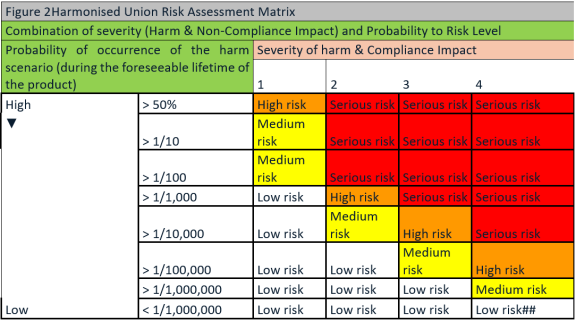
3.7.3.4 The application of the matrix will aid transparency in illustrating a market surveillance authority’s decision-making process. Where an economic operator is affected by a decision of a market surveillance authority, that operator may be better able to understand the market surveillance authority’s risk management decision if he/she is in a position to consider the harmonised Union methodology used by that market surveillance authority and documented within the ICSMS platform.
3.7.3.5 Proposals to prohibit, withdraw, restrict, or recall a construction product from the market, or to make its use subject to certain conditions, are likely to have significant cost implications for the economic operator concerned and, accordingly, such proposals may be subject to legal challenge in the absence of robust data in support of the approach being proposed by the market surveillance authority. In this context, to minimise the risk associated with a legal challenge, it is considered critical that the risk assessment carried out by the market surveillance authority (or by external expertise on behalf of the market surveillance authority) in order to establish ‘serious risk’ is clear, unequivocal, and robust in its methodology.
This robustness must extend to the identification of the hazards arising from the construction product, the identification of the subjects (i.e. persons, property, the environment etc.) that may be affected by such hazards, the determination of both the consequence/injury severity and the probability of occurrence, and, most importantly, the verification of technical documentation, Declaration of Performance and Conformity (DoPC) datasets, and Construction Digital Product Passport (DPP) registry metrics. The conclusions reached and actions taken must be legally resilient to ensure the safety, compliance, and environmental sustainability principles within CPR 2011, CPR 2024, and the European Union (Construction Products) Regulations 2025 (S.I. No. 669 of 2025) are upheld.
3.7.4 Directions by the Minister for Housing, Local Government and Heritage
3.7.4.1 Market surveillance data would suggest that in the overwhelming majority of cases where non compliances are found in consumer and non-consumer products, the risks arising do not fall into the most severe or serious category. In the majority of cases, it is envisaged that market surveillance activity undertaken by market surveillance authorities will principally comprise of actions taken in accordance with Stages 1 to 4 of these guidelines which are largely aimed at addressing non compliances which do not give rise to serious risk. Action under Stage 5 should only be considered by a market surveillance authority where:
- a serious risk has been identified by the market surveillance authority in relation to the use or environmental compliance parameters of a construction product,
- a formal risk assessment in respect of that construction product has been carried out by the market surveillance authority utilizing the harmonised Union methodology, and
- the relevant economic operator has failed to comply with a statutory Compliance Notice or Enforcement Notice issued by the market surveillance authority under Regulations 11 and 12 of the European Union (Construction Products) Regulations 2025 (S.I. No. 669 of 2025), requiring corrective actions to be completed within the specified period of time.
3.7.4.2 Where a serious risk has been identified in respect of a construction product on the basis of a risk assessment, a market surveillance authority shall serve an Enforcement Notice under Regulation 12 of the European Union (Construction Products) Regulations 2025, requiring the economic operator to take definitive corrective actions within a specified period of time. Failure by an economic operator to comply with the mandates of such an enforcement notice constitutes a serious statutory offence under the regulations. In accordance with Regulations 14 and 15 of the European Union (Construction Products) Regulations 2025, such non-compliance may result in the market surveillance authority executing immediate local market restrictions and requesting the Minister for Housing, Local Government and Heritage to issue a formal Ministerial Direction to permanently enforce measures or to trigger a national alert. This request may seek to compel the economic operator to:
- prohibit or restrict the construction product from being made available on the market,
- withdraw it from the market if already available on the market,
- recall it from the market if already available on the market or installed within construction works where a structural or environmental hazard persists, or
- make its use subject to special or restricted technical conditions.
3.7.4.3 In the event that a market surveillance authority proposes to request the Minister for Housing, Local Government and Heritage to issue a direction to an economic operator to either prohibit, withdraw, restrict, or recall a construction product from the market, or to make its use subject to certain conditions, the market surveillance authority shall inform the economic operator:
- of its intention, after the expiry of the period of no greater than 14 days commencing on the date of notification, to request the Minister for Housing, Local Government and Heritage to issue a direction under Regulation 14 of the European Union (Construction Products) Regulations 2025 (S.I. No. 669 of 2025),
- of the terms of the direction, it intends to request the Minister for Housing, Local Government and Heritage to make, including in particular the exact grounds, technical assessment thresholds, or environmental non-compliance indicators supporting that direction,
- that it will consider any representations on the matter made by the economic operator within the period specified in paragraph (a) above pursuant to the 'right to be heard' provisions under Article 18 of Regulation (EU) 2019/1020, and
- of the appeal procedure and statutory remedies available under Regulation 19 of the European Union (Construction Products) Regulations 2025.
Any representations made by the economic operator should be objectively considered by the market surveillance authority in advance of any decision being made to request the Minister for Housing, Local Government and Heritage to issue a direction under the Regulations 2025.
3.7.4.4 Where the market surveillance authority maintains its decision to request the Minister for Housing, Local Government and Heritage to issue a direction, a copy of the economic operator’s representations and the market surveillance authority’s comments thereon should be provided to the Minister for Housing, Local Government and Heritage via the NBCMSO coordination channel.
3.7.4.5 It should be noted that in an emergency situation where rapid intervention is considered critical due to an imminent serious risk to health, safety, or irreversible environmental degradation, the requirement on a market surveillance authority to consider representations from the economic operator prior to taking measures may be dispensed with under Article 18(3) of Regulation (EU) 2019/1020. However, if action has been taken without the economic operator being heard, that economic operator shall be given the opportunity to be heard as soon as possible, and the action taken shall be reviewed promptly thereafter by the market surveillance authority. Both the economic operator and the Minister for Housing, Local Government and Heritage should be notified of the outcome as soon as possible thereafter.
3.7.4.6 In advance of issuing a request to the Minister for Housing, Local Government and Heritage, under Regulation 14 of the European Union (Construction Products) Regulations 2025, a market surveillance authority shall, as a minimum, provide the information set out in section 3.7.1.4 and shall, insofar as it is appropriate, collate the additional information required under Articles 56 or 58 of CPR 2011, the corresponding compliance frameworks of CPR 2024, and Articles 19 to 21 of Regulation (EU) 2019/1020 respectively.
3.7.4.7 In the event that any of the restrictive measures mentioned above are applied in respect of a construction product, the Minister for Housing, Local Government and Heritage is obliged under Articles 56 and 58 of CPR 2011, relevant provisions of CPR 2024, and Regulation 15 of the European Union (Construction Products) Regulations 2025 to notify the European Commission and other Member States of the European Union through the ICSMS platform (and Safety Gate where applicable) to trigger the formal Union Safeguard Procedure.
3.7.4.8 Pursuant to Article 57 of CPR 2011, where no objection is raised by either a Member State or the Commission within a period of three months of receipt of the notification, the restrictive measures taken by the Irish authorities shall be deemed justified and executed across all Member States.