
3.0 Market Surveillance in Practice
This chapter describes the practical process to be followed when carrying out market surveillance activities for construction products. It covers the targeting and selection of products and economic operators, sampling and inspection, compliance assessment, follow-up measures, and case closure and reporting. The process should be applied in accordance with the applicable Union and national legislation and the principles described in Chapter 2.
3.1 Overview of Market Surveillance
Market Surveillance of construction products is carried out in accordance with the guidance provided in the “GOOD PRACTICE FOR MARKET SURVEILLANCE Aug 2025”. This guidance reflects good practice in the field of market surveillance and aims to contribute to a better understanding and consistent application of EU rules on market surveillance of non-food products across different sectors.
The guidance was prepared by the EUPCN (EU Product Compliance Network) established under Regulation (EU) 2019/1020 on Market surveillance and Compliance of Products Working group consisting of SLO (Single Liaison Office) representing the Member States and AdCos(Administrative Cooperation Groups) Chairs representing the harmonised sectors.
The guidance provides a general cross-sector framework for market surveillance. This chapter applies that framework to construction products and the Irish market surveillance context.
3.1.1 Proactive and Reactive Market Surveillance
Market surveillance activities may be carried out proactively or reactively:
- Proactive market surveillance refers to planned market surveillance activities, including market screening, targeted campaigns, inspections and product sampling.
- Reactive market surveillance is undertaken in response to an external event or information, such as an accident, complaint, notification, customs referral or other market intelligence requiring investigation.
In both cases, a targeted and risk-based approach should be used to select the relevant products and economic operators and to determine the appropriate level of market surveillance activity.
3.1.2 Key Principles of Effective Market Surveillance
Effective market surveillance is based on a strategic approach where Market surveillance focuses on monitoring products efficiently rather than inspecting every item on the market. It uses a targeted, risk-based approach to select products, apply appropriate controls, and implement effective and timely follow-up actions. Surveillance activities may be proactive or reactive, ensuring resources are used effectively to achieve compliance and safety objectives.
The principle of proportionality, as provided for in Article 14(2) of Regulation (EU) 2019/1020, requires market surveillance authorities to take actions that are necessary and appropriate to achieve compliance. When deciding on corrective measures, authorities should consider the seriousness of the non-compliance and the potential risk, including the severity and likelihood of harm.
Cross-Border Cooperation is essential for effective market surveillance. Articles 22 and 23 of the Regulation (EU) 2019/1020 provide for mutual assistance between market surveillance authorities, while Article 34 of Regulation (EU) 2019/1020 establishes the Information and Communication System for Market Surveillance, the ICSMS as a common database, and participate in AdCo meetings and joint actions to ensure consistent and effective enforcement across the Single Market.
The exchange of Information Through IT Tools (e.g. ICSMS) is a key element of EU market surveillance. Systems such as ICSMS enable authorities to share information, coordinate enforcement, record compliance investigations, manage mutual assistance requests, and support consistent, effective cross-border market surveillance throughout the Single Market.
Market Surveillance Authorities should also identify and engage with the relevant economic operator responsible for placing the product on the EU/EEA market. EU product legislation assigns specific obligations to economic operators according to their role in the supply chain.
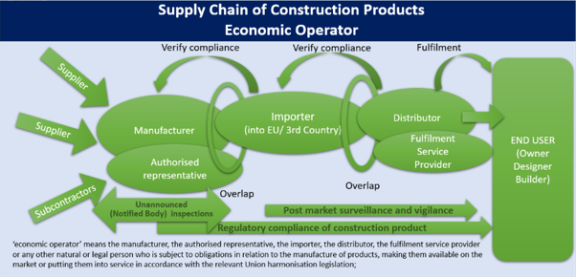
Market Surveillance Authorities should also identify and engage with the relevant economic operator responsible for placing the product on the EU/EEA market. EU product legislation assigns specific obligations to economic operators based on their role in the supply chain.
Where appropriate, corrective action should be sought from the relevant manufacturer or importer before, or in parallel with, action involving national distributors. This supports the implementation of corrective measures across the EU/EEA market rather than only within one national market.
This approach helps ensure corrective measures are implemented across the EU/EEA rather than only within one national market. For sectors covered by the EU-Switzerland Mutual Recognition Agreement, non-compliance should also be addressed in Switzerland as well as the EEA.
3.1.3 Authorised Officers
Authorised Officers are appointed under Regulation 8 of S.I. No. 669/2025 - European Union (Construction Products) Regulations 2025:
8(1) For the purpose of Market Surveillance i.e., investigation, prevention, detection or prosecution of offences under these Regulations:
- a building control authority or a market surveillance authority shall appoint officers to be authorised officers for the purpose of these Regulations, and
- a competent authority shall, other than where the competent authority is an individual, appoint officers to be authorised officers, and where the competent authority is an individual that person shall be an authorised officer, for the purposes of these Regulations.
(2) An authorised officer shall be furnished with a warrant of his or her appointment as an authorised officer and, when exercising any power conferred on him or her by these Regulations, shall, if requested by any person affected, produce the warrant to that person.
The template for appointing an authorised officer is provided in Appendix V of these Guidelines.
3.1.4 Powers of authorised officers
Authorised officers appointed under Regulation 8 of S.I. No. 669 of 2025 have powers to investigate and enforce compliance with the applicable construction products legislation. Subject to the conditions set out in Regulation 9, these include powers to:
- access relevant places of manufacture or storage, and vehicles used to transport construction products, and carry out inspections, evaluations, examinations and tests;
- initiate investigations, including unannounced on-site inspections and physical checks of construction products;
- request technical documentation and require information about supply chains, distribution networks, products and relevant records;
- require relevant personnel to produce information and provide explanations;
- copy or take extracts from records, and take photographs of construction products and relevant places of manufacture or storage;
- select and acquire product samples and carry out, or arrange, evaluations, examinations, tests or reverse engineering; and
- where the statutory conditions are met, direct an economic operator by written notice to take corrective action within a specified period.
Regulation 9 also provides for measures concerning online interfaces where no other effective means are available to eliminate a serious risk. Entry into a private dwelling requires the occupier’s consent or a District Court warrant under Regulation 10.
Authorised officers must take reasonable measures to protect the confidentiality of technical documentation and other information supplied to them. Separately, Regulation 7 provides for information sharing and cooperation by market surveillance authorities. Where the conditions in Regulation 9(5) are met, the market surveillance authority may recover certain costs of evaluating, examining or testing a non-compliant product.